
Join the Menttor community
Track progress and collaborate on roadmaps with students worldwide.
Kitaev Toric Code
Kitaev, A. Y. (2003). Fault-tolerant quantum computation by anyons. Annals of Physics, 303(1), 2-30.
Read Original Paper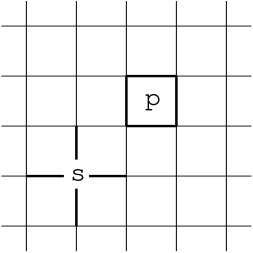
The challenge of fault tolerance in early quantum computing research stemmed from the extreme sensitivity of qubits to decoherence and the high precision required for gate operations. While Shor’s threshold theorem proved that computation was theoretically possible with imperfect gates, the required error rates presented a nearly insurmountable engineering barrier.
Alexei Kitaev’s 1997 proposal shifted the strategy from active, software-level error correction to passive, hardware-level protection by drawing an analogy to classical magnetic storage. Just as ferromagnetism uses local interactions to stabilize global alignment against thermal fluctuations, Kitaev sought a quantum system where the correct state is a gapped ground state protected by the physics of the system itself.
Topological Stability on the Torus
Square lattice on the torus
Stabilizers and the Lattice
The primary mechanism for this protection is the toric code, a stabilizer code defined on a two-dimensional lattice. In this model, qubits are placed on the edges of the lattice, and the Hamiltonian is constructed from local commuting operators: vertex operators and face operators.
The ground state of this system is the subspace where all stabilizer conditions are satisfied. On a surface with non-trivial topology, such as a torus, this ground state is degenerate, and the different states cannot be distinguished by any local measurement.
Global vs. Local Degrees of Freedom
Because local perturbations cannot see the global topological state, the energy splitting between these states vanishes exponentially with the system size, effectively shielding the encoded information from local noise. This suggests that the most robust way to store quantum information is to hide it in the global properties of a system rather than in individual particles.
A critical nuance is that the number of logical qubits is determined solely by the genus (the number of holes) of the surface. For a torus, which has a genus of one, the system provides two logical qubits, proving that geometry can be mathematically transformed into memory.
Anyonic Excitation and Braiding
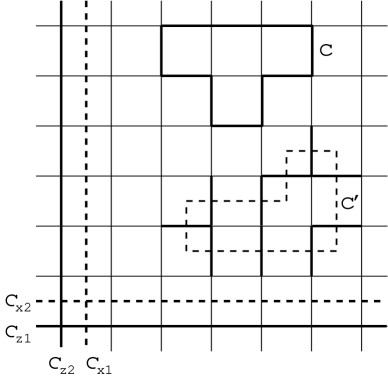
Loops on the lattice and the dual lattice
Creation of Quasi-particles
Excitations in this system behave as anyons—quasi-particles that exist only in two dimensions and possess statistics intermediate between bosons and fermions. In the toric code, these anyons are created in pairs at the ends of string operators, which are products of Pauli matrices along a path on the lattice.
Braiding and Topological Gates
Moving a magnetic vortex around an electric charge results in a phase shift of , a hallmark of abelian anyons. In more complex non-abelian models, the state space of multiple anyons is multi-dimensional, allowing for the execution of quantum gates through the physical movement of these particles. Braiding these anyons—physically moving them around one another—induces non-trivial unitary transformations on this protected subspace.
Fusion and Measurement
Computation is thus executed through the topology of the anyon trajectories, while measurement is performed by bringing anyons together and observing the resulting particle type through a process known as fusion.
This work enabled a fundamental abstraction in quantum research: the transition from the circuit model of quantum computing to topological quantum computation. It introduced the concept of topological quantum order, where information is stored in long-range entanglement rather than local degrees of freedom.
By demonstrating that fault tolerance could be an intrinsic physical property of a gapped 2D system, Kitaev provided a blueprint for a topological memory that remains stable without constant external intervention. The search for materials that can naturally realize these robust quantum states remains an active frontier in condensed matter physics.
Dive Deeper
Fault-tolerant quantum computation by anyons
arXiv • article
Explore ResourceIntroduction to Topological Quantum Computation
arXiv • article
Explore Resource