
Join the Menttor community
Track progress and collaborate on roadmaps with students worldwide.
The Quantum Walk Algorithm
Childs, A. M., Cleve, R., Deotto, E., Farhi, E., Gutmann, S., & Spielman, D. A. (2003). Exponential algorithmic speedup by quantum walk. In Proceedings of the thirty-fifth annual ACM symposium on Theory of computing (pp. 59-68).
Read Original Paper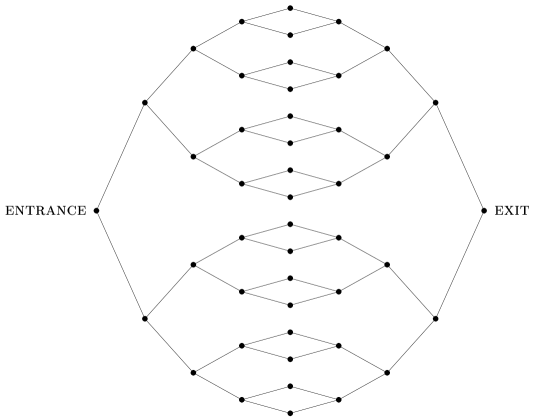
The proposal of quantum walks as a tool for graph traversal was driven by the need to find an exponential algorithmic speedup that did not rely on the hidden subgroup problem, which characterizes Shor’s algorithm. In classical computer science, random walks are a robust method for exploring graphs, but they are fundamentally limited by the hitting time, which can be exponential in the size of the graph for certain structures.
Childs et al. sought to demonstrate that the wave-like nature of quantum mechanics could overcome these classical bottlenecks, specifically in the context of the "glued trees" problem where a classical explorer becomes hopelessly lost in an exponential expanse of nodes.
The Mechanism of Wave Propagation
The graph G4
The Glued Trees Graph
The mechanism of this speedup is rooted in the continuous-time quantum walk, where the state of the system evolves according to a Hamiltonian that is equivalent to the adjacency matrix of the graph. The "glued trees" graph consists of two balanced binary trees of depth , where the leaves of the first tree are connected to the leaves of the second tree via a random cycle or matching.
In a classical walk, a particle starting at the root of the first tree will reach the leaves in steps but will then wander aimlessly among the leaf nodes, with a vanishingly small probability of ever finding the "glue" that leads to the second tree's root.
Hamiltonian Evolution and Interference
Conversely, the quantum walk utilizes Hamiltonian evolution to maintain a coherent superposition across the graph. Because the graph is highly symmetric, the quantum state effectively collapses into a one-dimensional subspace where the walk behaves like a wave propagating along a line.
This allows the quantum amplitude to tunnel through the junction of the two trees and reach the target root in polynomial time. The interference between different paths prevents the "trapping" effect that occurs in classical diffusion, enabling the state to propagate efficiently toward the target.
A New Paradigm for Speedup
Beyond Hidden Subgroups
This work enabled a global shift in quantum research by abstracting the concept of "computation" away from discrete logic gates and toward the simulation of physical dynamics. It proved that interference alone, without the need for a Fourier transform over a group, could provide an exponential advantage.
This established quantum walks as a primary algorithmic paradigm, leading to new methods for searching unstructured databases, evaluating NAND trees, and solving various spatial search problems that were previously thought to be intractable for quantum systems.
Algorithmic Generalization
The abstraction provided by the quantum walk suggests that many graph-theoretic problems can be viewed as wave propagation tasks. By mapping a computational problem onto a graph structure, researchers can leverage the spectral properties of the adjacency matrix to design algorithms that exploit quantum tunneling and constructive interference. Whether this paradigm can be extended to solve practical optimization problems on non-symmetric graphs remains an active area of investigation in quantum algorithm design.
Dive Deeper
Exponential algorithmic speedup by quantum walk (arXiv)
arXiv • article
Explore ResourceQuantum Walks and Their Applications
arXiv • article
Explore Resource